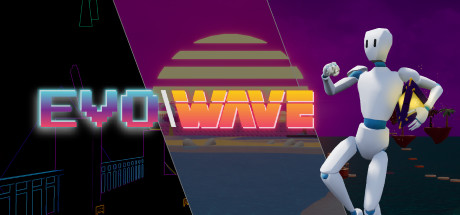
In Evo\Wave, the Villain Shares Her Name With the Studio
No deadline: it stays in the catalogue until the store pulls it.
Claim it on Steam ↗You claim it in your own store account; Clairo doesn’t claim it for you.
Availability can vary by region.
Behind MagnaVex Entertainment stands a group of Canadian students, and the very mechanic that hands old graphic eras back to the game's world is, for at least one player, a reason to grumble.
The Villain Bears the Name of the Studio That Made Her
The story's villain is named MagnaVex. The studio behind the game is named MagnaVex Entertainment. Within the fiction, it is that same force that shoved the world back into a retro era, and it falls to LAI-6 — a nonbinary artificial intelligence — to repair it, piece by piece, mending the core christened Evo\Core.
Every repaired piece returns a slice of gaming's visual history to the setting. You feel the shift before you grasp it: take a few steps and the color palette has already changed, as if the ground swapped decades under your feet. The era the screenshots lean on hardest is the '80s: a purple sky, aquamarine foliage, a spare but daring palette, set to an electronic score that echoes the Miami nights of that decade. Along the way, LAI-6 picks up a double jump and the ability to glide through the air, two tools that open vertical shortcuts across the levels.
Scattered across the levels are components of the Evo\Core and cards full of trivia about the real history of video games — the game teaches while it entertains. From the other side come system glitches and corrupted enemies, dispatched by MagnaVex to hinder the repair. The game's listing also notes a concern for visual accessibility, with fewer flashing lights and fewer low-contrast scenes, designed so that children and adults can play without the same discomfort.
A Graduation Project That Became a Game on Steam
MagnaVex Entertainment is tied to UQAT — Création et nouveaux médias, the distributor listed on the game's page. In the notes the team itself posted around the launch, in March 2021, they explain that Evo\Wave was the final project of a group of students, and they give thanks, taken aback, for the messages, the videos and the attention their little coursework earned beyond the classroom.
Read the update notes and you recognize the tone: these are people celebrating that they finished their final project, without the polish of a big studio. In those same days, the team chose not to sell the soundtrack: they posted the tracks, composed by students from UDEM, alongside the game on Steam and on YouTube. The updates that followed came quickly: fixes to the dialogue, to the scenery collisions and even a build for Windows 7 — the mark of a small release being tuned live, reply after reply, for the people already playing.
The Spin That Recalls Crash, and the Momentum It Loses
One player who showed up right as the game released, in March 2021, and spent only an hour with the controller, left a review on Steam comparing the character's spins to Crash Bandicoot's jump: simple, pretty, a quick diversion. Another player came back much later and put five hours into the game, describing that same feeling a different way: a short but well-built platformer that gains freedom of movement once the double-jump upgrade is unlocked, and whose length leaves you wanting more — enough to single out the soundtrack, too, as something worth attention. A third person, also with five hours on the clock, returned in April 2021 to praise the historical trivia hidden throughout the levels and the soundtrack, calling the whole thing a job well done.
If you've ever lost your momentum mid-jump in some other game, you know exactly what this complaint is about. Even among those who speak well of it, the same gripe recurs: a September 2026 write-up points out that the spinning jump loses its momentum in midair and drains a bit of the fun from the move — a small annoyance, logged by someone who had barely started playing.
When the Same Idea Becomes a Reason to Complain
You go in expecting nostalgia and, if you're anything like this person, you come out feeling you traded one ugly palette for a worse one. The dissenting voice in this group surfaced in May 2026, after just an hour of play, and got straight to the point: the movement abilities are good, with plenty of variety — it's everything else that grates. The levels balloon past what they should, the objectives wear thin, and the game's writing doesn't convince, even though the person admits to not caring much about story in a platformer.
The sharpest edge of the critique aims squarely at what the game sells as its central idea: for this person, the visuals don't improve as the Evo\Core is repaired — they get worse, one era after another. It's the same mechanic that led another player to compare the character to Crash Bandicoot, turned here into the reason for the complaint: what one person reads as nostalgia, another reads as regression.
Who It's Worth Repairing the Evo\Core For
Evo\Wave is for anyone who wants a short session steeped in references to gaming's own history, without demanding many hours of commitment: it's what the players who finished fast and still asked for more got out of it. It isn't for anyone expecting lean levels from start to finish or writing on par with the rest — that's exactly where the one dissenting take in the batch takes aim, and it lands. If a short, reference-packed session is what draws you in, you'll come away satisfied; if you expect the game to hold an even standard from the first level to the last, it's better not to count on it.
Repairing the Evo\Core changes the scenery; it doesn't change the fact that, for at least one person who played it, each new era looked worse than the one before.