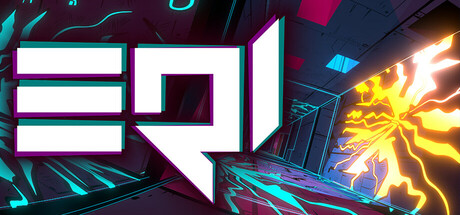
EQI: the world spins around you, and some of the players walked away queasy
No deadline: it stays in the catalogue until the store pulls it.
Claim it on Steam ↗You claim it in your own store account; Clairo doesn’t claim it for you.
Availability can vary by region.
Praise for the electronic soundtrack, complaints about trial and error — and a studio that has already gone back into the game's most hated level.
The world folds under your feet
There are no corridors here. You move across surfaces that fold, rotate and swap places while you try to work out where your next step lands. EQI is a first-person action-adventure built on more than 20 levels that grow in size and difficulty, each one demanding quick reflexes and spatial reading rather than classic puzzle logic. The store page talks about crossing a great mystery and coming out transformed. A player with less than an hour logged, in April 2021, describes something else entirely: a square box full of traps that kill instantly, with pulsing electronic music underneath — and accuses that same store description of promising one thing and delivering another.
Chopin et al. released the game on January 15, 2021, with Hyperstrange handling distribution. It is a single-player title, tracks Steam achievements and allows family sharing — but controller support is only partial, and a game that demands precise jumps feels the gap.
The bridge the studio had to fix twice
In a post on the studio's community board in February 2021, the developers write that one level in particular — the Long Bridge — kept coming up among players as the most frustrating stretch in the game. Their answer: move the checkpoint closer to the hard section, shorten the walk back after every fall, and reshape the geometry so the jump no longer asks for millimeter precision. Still in February, announcing Chinese language support for Lunar New Year, that same board adds another checkpoint to that same bridge, swaps out the level's music and changes the backdrop — one stretch polished twice in the space of a few weeks.
You still fall off that bridge at least once — except the restart point sits closer to the hard part, because other players fell there first and said so.
A recommendation with strings attached, three hours in
The most recent verdict gathered here is dated September 24, 2026, from someone who spent three hours in the game and, complaints and all, recommends it. Momentum gets in the way: in mid-air you control nothing, and the way you react on touching a surface comes out differently every time. Even so, the concept works for this player — the levels vary, and the visuals are clean and well kept. There is no option to remap the keyboard, an irritation of its own. The recommendation comes with a condition attached: it suits people who enjoy fast reflexes and do not mind stumbling a great deal; it is not an open invitation.
Trial, error, and real motion sickness
The store sums up the game's reception as broadly favorable; the voices gathered here, though, lean more toward complaint than praise. One criticism repeats from 2021 to 2024: the controls do not do what they promise. A player with one hour logged in August 2021 describes simple stretches turning into trial and error, because the right angle and speed for a jump follow no visible logic. Another, back in February 2024 and also after an hour, boils the mechanic down to hopping from platform to platform while rotating a block in mid-air to line up the landing — and calls the graphics painful to look at. A third, with two hours logged in February 2021, got almost all the way to the end, praises the science-fiction setting and the graphics, but warns that the thin explanation pushes you into dying to learn: the first attempt rarely works. For that player the balance tipped toward action rather than thinking — anyone after a real puzzle risks giving up halfway.
The player with less than an hour logged, in April 2021, goes further and accuses the store description itself of misleading. In their reading, what is there is not an electronic score guiding the senses but a square box full of traps that kill instantly, with ambient sound in the background. You never see the threat coming — you just memorize, after dying once, where it lands the next time. In December of that year, another account shifts register: a headache within a few minutes of play, and a warning to anyone with balance problems to stay away — for that person the discomfort was worse than airsickness.
Not everyone reads the difficulty as a flaw. A player with zero hours logged, in April 2024, sums the game up as extremely hard but well designed — not to their own taste, they write, but right for anyone who likes their puzzles in masochist mode. Another, with one hour played in January 2021, frames the problem as pacing: the opening never explains the rules, the middle burns time on repetitive action, and the ending punishes you for the missing checkpoints — neither the puzzles nor the action is genuinely hard; what wears you down is how long it all takes.
For players who count falling as part of it, and for those who don't
EQI is for players who treat a fall as part of the game rather than a fault in it — the kind who enjoy learning an obstacle's behavior by heart, run after run, and do not mind replaying the same stretch to get the angle of a jump right. It is not for anyone who came looking for calm: the body works harder than the mind here, and if what you wanted was to solve a puzzle sitting still, you will quit early. It is also not for anyone whose stomach turns at a swaying first-person camera — that is not a figure of speech, it is a warning left behind by people who played it. One image sums up where the game lives: it promises transcendence and delivers a bridge the studio itself has already had to fix twice.