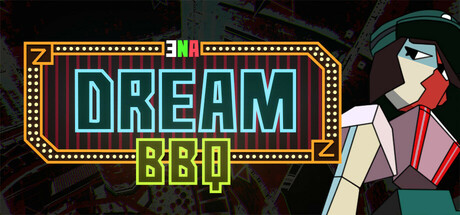
In ENA: Dream BBQ, the cast doesn't even share a language
No deadline: it stays in the catalogue until the store pulls it.
Claim it on Steam ↗You claim it in your own store account; Clairo doesn’t claim it for you.
Availability can vary by region.
The first chapter of Joel G's series splits the players who board the dream from the ones who step off at the first station — and it says up front that the chapters to come will be sold separately.
A boss nobody wants to be, in a world that never repeats its own rule
ENA works for someone and sets out to become the Boss that everyone at the job dreams of being someday. You walk into a scene with no grasp of its logic yet, and the only way to learn it is to get it wrong: every new setting swaps its own rules the moment the door shuts behind her. Along the way, ENA takes odd jobs and runs into sweet and sour characters who only wanted to use her to settle problems of their own, with tools as strange as everything else in the game — the store page sums the tone up as the experience of being the least popular person at any party.
This is the first chapter of a franchise Joel G turned into a game after years as an animated series on YouTube — the chapter 'Lonely Door', which the studio ENA Team released on March 26, 2025. The store page itself states that the chapters to follow are already in production and will arrive as a paid release: what exists is only the first cut of a larger story. There is also a sensitive-content warning — flashing lights that may affect people with photosensitive epilepsy, plus scenes and language that part of the audience may find disturbing.
Finish it twice and the only question left is chapter 2
If you have ever woken up trying to piece the details of a dream back together, you recognize the effect the game is chasing: a run of scenes that changes its rules without warning, the way dreams change. Several reviews note how the cast members speak in voices and accents of their own, almost always tied to a different nationality — a trait carried straight over from the YouTube series Joel G published long ahead of the game, and one nobody found lost in the adaptation.
The player who reached four hours had already finished the story twice, and planned on one more run — not for the final score, but to keep any secret tucked into the scenery from slipping past. That account is dated August 30, 2026. This willingness to go back charges a price that is not measured in money: a reviewer with a similar playtime wrote, on September 5, 2026, that they would take a biblical ordeal over facing the one achievement still missing from their list again. The praise here is not gentle — it comes from people who grumble about the game without ever putting it down.
One hour in, some players found a handsome, empty museum
The harshest criticism does not target the visuals — it targets the walking around with nothing to do. The complaint that comes up most describes a guided tour: follow the markers, listen to dialogue in languages much of the audience does not speak, with no way to steer the scene. You follow the pointer, hear a line you cannot decode, press again — and nothing feels like a decision you made. For this crowd, the mystery turns into decoration, and decoration wears thin.
The player who stopped at one hour sums the experience up as beautiful and shallow at once, with nothing to carry curiosity past the first room. That account is dated September 18, 2026. This unhappy wing softens its own criticism too: a reviewer with eight hours in, driven up the wall over the game's most obscure achievements — the dog one in particular nearly did them in — closes with the line that the game itself is good. That account is dated September 5, 2026. The gripe is with the trophy list, not with the world the list is trying to measure.
For players willing to sit through a scene without grasping its rule
The split here is not liked it against did not like it — it is what the game charges to deliver what it promises. It asks you to tolerate leaving a scene without having quite understood what it meant, to walk after prompts with no clear instruction, and to live with lines in languages much of the audience does not speak. Players who pay that toll willingly come out counting the secrets they found along the way; players who expect a visible goal in every room give up in the first one.
Lonely Door is only the opening: the rest of the story, according to the store page itself, will arrive as a separate product, sold on its own. Finishing this chapter does not close the work — at most, it settles whether you want to come back for the rest of it once it exists. For players who will take a world that does not explain itself, ENA: Dream BBQ guarantees strange company from the first scene to the last. For players who need a clear rule from the title screen on, this is not the invitation.