Deponia: a hero worth rooting against
It’s no longer being given away · it costs US$9.99 again
See it in the store ↗This page stays as a record of what was given away.
Availability can vary by region.
A junkyard world, a fall from the sky, and puzzles so twisted that even the players who praise the game admit they reached for a walkthrough.
A junkyard, a fall from the sky, and a crooked plan
Some games want you to root for the hero. This one has you rooting against him: you want to watch Rufus take a punch, get thrown into a cactus, fall from somewhere very high — and it's precisely because they enjoy him like this that plenty of people stay to the finish.
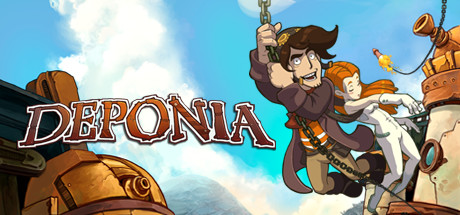
Deponia's world has turned into one massive junkyard, and Rufus is stuck at the very bottom of that heap of refuse. His luck seems to turn when Goal, a woman from the city that floats above the clouds, drops out of the sky right onto his pile of trash, and he decides to help her get home. Along the way he learns that her husband is already dead, hatches a plan to climb up to the floating world himself, and ends up falling in love — which tests what few scruples he has left.
The art is hand-drawn, in a high-definition comic-book style, and the store's own copy compares the tone of its universe to names like Douglas Adams and Terry Pratchett — British comedy of absurd worlds and characters on the fringes. It's good company for anyone who likes acid humor and isn't in a hurry: the material promises many hours of dialogue and puzzles that are anything but obvious, all the way up to the clouds.
A trilogy brought to a close, and support that didn't stop at launch
The German magazine GameStar dubbed Daedalic Entertainment — the game's studio and publisher both — "the German Lucasarts." Years after release, in 2019, the team was still coming back to tinker with the game: it updated the engine, synced saved progress across platforms, and added subtitles in Arabic, Korean, and both variants of Chinese.
Rufus's story didn't end with this first game: it became a trilogy, closed out with Deponia Doomsday. When that final chapter arrived, British critics summed up the tone with a wink — the series refused to go away, and its hero stayed as insufferable as the fans had come to expect, as if being annoying were, here, another word for funny.
A charming disaster, and a coffee maker that runs on improvisation
In French, a review written after 14 hours of play compares Rufus to a classic klutz: a selfish, bumbling man brimming with self-assurance, with a natural gift for turning any situation into a catastrophe — and that's the very reason the piece gives for liking him. In Russian, another review sums the protagonist up as an idiot in a world of idiots, and makes a point of praising the soundtrack on its own.
The puzzle logic is where the praise stumbles, even for those who enjoyed it. One Russian review describes the recipe for getting clean water in a coffee maker: mixing battery acid, the blood of a mechanical bull, and whiskey inside a wine glass — and it works, within the game's own crooked logic. A Brazilian review, written after 7 hours of play, admits to having turned to a walkthrough several times, calls the story weak but stands by the humor, and recommends the game only to those who pick a day with nothing else to do.
An English review confirms that limit: it describes the game as captivating but niche, slow-paced, almost devoid of hints, genuinely hard — the reviewer finished it once and feels no urge to start over. Anyone who likes old point-and-click adventures will recognize the genre; anyone who doesn't can skip it guilt-free.
The bug that freezes the game, and a hero as irritating as he is entertaining
A Brazilian review was logged with 0 hours of play: it found the dialogue draggy and watched any desire to keep going vanish far too quickly. In English, a 3-hour review reports that a bug crops up about an hour in and blocks all progress — the game freezes and there's no way to finish it.
Another English review, also at 3 hours, describes the same freeze — and adds a detail: according to the writer, the studio has already announced it won't invest any further in fixes, even with the game still on sale. In German, a 7-hour review recounts that the magnet bug was only resolved by downloading a save file sent by support, and that a rotating-piece puzzle further on spun endlessly and never clicked into place. Chinese and Korean reviews echo the same complaint: without a walkthrough open beside you, there's no guessing the next step.
The harshest complaint, though, isn't about a technical fault: it's about Rufus. Two Chinese reviews, at 3 and 7 hours, describe the protagonist as someone who lives off other people: he sleeps in someone else's house, eats and uses what isn't his, steals what he can, and even mistreats a pet cat — the exact opposite of the charming disaster the French review praised. The difference between loving and loathing Deponia, in the end, comes down to the same thing: how much each reader can stand rooting for a scoundrel of a hero.
Who it's for, this rooting against your own hero
Deponia is for people who like to chew on puzzles that defy any obvious logic, who have the patience to open a walkthrough without feeling defeated by it, and who don't mind rooting against the hero rather than for him. It's less suited to anyone after a light story or generous hints — and even less to anyone who can't stand having their progress frozen by a bug that the studio itself, according to a recent review, has decided to stop fixing.
Whoever steps into Deponia won't find a hero to admire: they'll find one to laugh at in his misfortune, and that, more than any puzzle, is what decides whether the game grips you or wears you down.