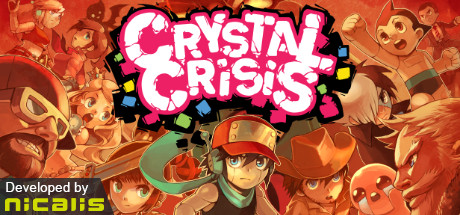
Crystal Crisis: Quote, Astro Boy and Isaac share one board of falling crystals
It’s no longer being given away · it costs US$19.99 again
See it in the store ↗This page stays as a record of what was given away.
Availability can vary by region.
Borrowed heroes from other franchises get you in the door; it's the falling crystals that make you stay.
The crystal that leaves one edge of the board and comes back on the other
Quote climbs out of the sunken cave of Cave Story to trade blows with Astro Boy, Isaac from The Binding of Isaac and Umihara Kawase — a lineup you won't find anywhere else. Twenty faces like these share the same board, and every duel is settled not by fists but by stacking the crystals as they fall and clearing your screen faster than your rival, in a game that bills itself as a fighter without ever landing a single punch.
The board has a trick few rivals in the genre bother with: a crystal that slides off one edge pops back in on the other, and you can split a pair to send one half to each corner — enough to make you watch your opponent's board as closely as your own. Landing chains fills a gauge unique to each fighter; once it's full, it unleashes a move that fouls up the other side or bails out your own. Every character on the roster gets a stage, a soundtrack and lines of their own, and the game ships with a color adjustment built for players who struggle to tell shades apart.
Beyond the head-to-head, you can play on your own: one mode ramps up the difficulty stage by stage, another measures how long you can hold out, tag teams swap in and out, and a training mode drills the moves into memory, alongside a story mode whose paths branch with your choices. And you can pull friends onto the couch or take on strangers anywhere in the world without leaving the house.
The spectator mode that didn't land until the 2021 update
The launch post, published on July 31, 2019, spells out what the Steam version brought: graphics options, keyboard remapping, extra languages, voice chat and word that a mode for watching matches from the sidelines was on the way. That spectator mode only actually turned up in an update published on July 8, 2021 — and it arrived beside something bigger: from that point on, you could take on people playing the Nintendo Switch version or the Epic Games Store version without leaving Steam.
If you had followed the studio's feed since launch, you saw the promise kept only in that later update. Nicalis went back to its own post to deliver what it had pledged at launch, rather than letting the promise die in a footnote — the kind of detail that separates an abandoned game from one that keeps getting attention, even if the keyboard remapping it promised, as becomes clear further down, never reached everyone.
The echo of Super Puzzle Fighter that players spot first
Anyone who comes in thinking of Tetris or Puyo-Puyo recognizes the skeleton within seconds, and that's what the older write-ups keep coming back to, each in its own words. Logging 18 hours across 2022, one review calls the game a fine way to pass the time, with plenty of ways to play packed into one box. Eight hours in 2020 were enough for someone else to be reminded of Super Puzzle Fighter down to the last detail. Whoever arrived back in 2019, with 13 hours on the clock, sums up the family tree as a joke: the game would be the offspring of Super Collapse and Puzzle Fighter. The roster borrowed from other franchises grabs your attention first, but what keeps you around is that the way the crystals lock together wins you over on its own.
The more recent write-ups, from July 2026, praise the soundtrack and the presentation, and describe the mix of indie-game characters with established names as a rare success. But even those who recommend it run into friction: someone who played 2 hours in June 2026 likes how many solo modes there are and doesn't find the characters as unbalanced as other accounts suggest — and yet still complains about one specific move, Astro Boy's spin, which locks up the entire board while it's active. You're one placement away from turning the match around when the game simply stops: that's the price the fans themselves pay.
Remapping on the keyboard, not on the controller
Someone who comes in having never touched anything in the Puzzle Fighter family, and only out of curiosity after watching another person play, sums up the discovery this way: it takes more thinking than it looked like from the outside. The 9 hours logged on June 24, 2026 earned praise for the story mode, the extra modes, the art gallery and the color adjustment for players who struggle to tell shades apart — and also two complaints that aren't merely cosmetic.
You settle in with the controller expecting to swap the buttons around, the way you can on the keyboard, only to find that option isn't here. The second complaint weighs more heavily on anyone who likes a sense of progression: the characters all come unlocked from the start, with nothing to earn, and unlocking them was exactly what this player expected from a roster that big.
For the player who sits down to read the rival, not to collect
It's for players who enjoy reading the opponent's board as much as their own — the crystals that vanish off one side and return on the other give you one more reason to watch the whole screen, not just your half. It's also for anyone who wants to gather friends on the couch or try their luck against strangers: a roster borrowed from so many different franchises is a conversation-starter from the very first round.
It's not for the player who uses a controller and won't give up rearranging the buttons — that option is still missing. And it's not for anyone who likes opening a fighting game and earning the roster piece by piece: here, every name is on the table from the first minute, and whoever hoped for the unlock hunt goes without it.