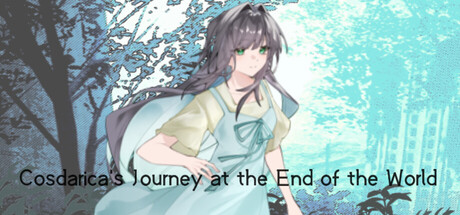
Civilization gave up on living. Cosdarica didn't.
No deadline: it stays in the catalogue until the store pulls it.
Claim it on Steam ↗You claim it in your own store account; Clairo doesn’t claim it for you.
Availability can vary by region.
A visual novel that lasts a few minutes split its players two ways — the atmosphere on one side, the sense of an unfinished story on the other. After release, the studio itself called that split fair.
Walking after everyone else stopped
Civilization spent its last spark. The survivors shut themselves into safe zones to wait out death in peace. Cosdarica turned the shelter down and kept walking — and took the voice that narrates this story along with her.
It is a visual novel: the story moves as you read, with no combat and no choice that bends the path — one ending, no variations. The whole journey fits in a single sitting, twenty to forty minutes, with original artwork and an original score. It came out on 27 July 2026 from Nowamension Games, credited both as the studio and as the publisher.
Steam files it under casual, indie, RPG and simulation, but players describe something plainer: a piece of reading about the end of the world, neither an RPG nor a simulation in any real sense. Few people have played it, and the store's own gauge sums the reception up as very positive — yet across the handful of written reviews, those who liked it and those who didn't disagree for entirely different reasons.
The studio sides with its critics
Two weeks after release, Nowamension Games put out a statement and did what few studios do: it read every criticism it had received and put its name to most of them. The list the studio accepted as valid covers the plot — vague, full of loose ends, muddled in its logic — the writing, with dialogue padded out and far too much of the world explained aloud, and the game's own title, which promises a journey and delivers little of it.
The list also takes in the moments when the game starts addressing the player directly — a device that, by the studio's own reckoning, serves no purpose. The statement ends without reaching for an excuse: the team says it listened, took the hit and moved on.
More staying power than the journey asked for
The players who recommend it aren't talking about an apocalypse of firefights and rubble. They're talking about someone who keeps walking while everyone around her has settled in to wait for death — and about how that turns, step by step, into a story about curiosity and stubbornness rather than survival.
One review dated 28 September logs ten hours of play on that short journey — plenty of room for someone who stopped, doubled back, or simply refused to rush the ending. The same review warns that what the store page calls an RPG and a simulation is, in practice, a read.
Not every compliment in this camp is a wholehearted one. A review from 13 September recommends the game but points out that the store had already put up a kind of sequel while the original story was still absent from Steam — and promises to revisit its verdict if the rest never turns up. For its author, the content itself is thin; even so, it does the job.
Two voices, not one choice
The players who advise against it point at the same architecture: the story is carried by two voices talking to each other, with no decision that alters what comes next. A review from 15 August describes the bluntest test of all — set to advance on its own, with nothing to choose along the way, the game is over in a matter of minutes.
Another critic, writing on 8 August, praises the artwork — the one element that really stands out — but is baffled by everything the script reaches for: geopolitics, environmental collapse, a school exam, all of it named and none of it pursued. At the end the game breaks the fourth wall and starts speaking straight to the reader, and the reaction on record is bewilderment rather than impact.
Not every dissenting voice is hostile. A review from 10 August admits the prose is dense, thick with off-putting jargon, and impossible to recommend with any conviction — then concedes that its cold portrait of the world ending kept the reader company at precisely that moment, joyless as that company was. And anyone expecting a pair facing the end of the world shoulder to shoulder comes away let down: the journey the title promises is not quite the one the script delivers.
For slow readers, not for people who want to play
Judge it by what it is, not by the genre the store picked for it: there is no combat, no choice, no second ending waiting to be found later. It is one reading session, the kind you do in one go, with someone explaining why it is worth walking on after everyone else has stopped.
It suits readers who can take a game that ends without digging into what it raises — geopolitics, environmental collapse, the school exam it barely grazes — and who would rather keep the atmosphere than demand a ready answer. It won't suit anyone who wanted a pair taking on the end of the world together: that journey, as the studio has already conceded, is not quite the one that shipped.
What a few minutes of reading leaves behind is a single image: someone who decided not to sit and wait for death. Anyone who wanted a whole world to explore comes away feeling they read the summary of what it could have been.