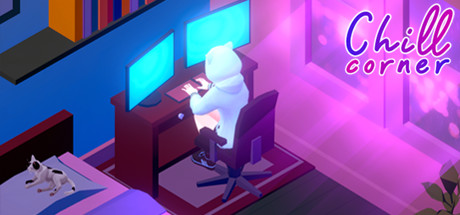
Chill Corner: a room to unwind in, parked in the corner of your screen
No deadline: it stays in the catalogue until the store pulls it.
Claim it on Steam ↗You claim it in your own store account; Clairo doesn’t claim it for you.
Availability can vary by region.
The game asks for nothing but screen space, yet its rewards cost hours — and the servers are kept alive by a studio of one.
A room that asks for nothing, and still charges you
To keep the servers running, the studio behind Chill Corner is building a psychological horror game on the side. That tension is the whole project in miniature: a calm space with no danger anywhere in it, paid for by someone who has to manufacture fear to cover the bills. Inside the game, your computer screen becomes a small room you can decorate, with its own lighting and mood, a quiet instrumental soundtrack underneath and a pet to look after while you get on with something else in real life.
There is no plot to finish and no boss to beat. You dress your avatar, decorate the room, line up the day's tasks and build your own playlist — and the game sits there in the background, waiting for the next time you glance over. Chill Corner came out on December 17, 2021, made by the small outfit Low-Hi Tech, and runs on Windows only.
One person, one studio, behind the quiet room
Low-Hi Tech is, in practice, a single person: the developer who signs off as Du, or lowhi. In a statement, he says most of the projects in his own catalogue no longer cover their upkeep, and that he had been paying for the Chill Corner server out of his own pocket. The move to a new server, announced in January, was completed on February 10, 2026.
To carry that bill, Du has revealed that he is building a psychological horror game alone in his spare time, in the vein of the Fears to Fathom series, and is asking anyone who likes Chill Corner to keep up with the new project's wishlist as a way of helping pay for the first game's server. It is the cosy room turned inside out: horror bankrolling comfort. Use the room to unwind and you are also, without noticing, keeping its opposite afloat.
In May 2025 the studio announced that the game had left early access and reached its first full version, with the progress of everyone already testing it carried over. The following month brought a crossover with another small game, Ursid: Chill Corner gained a new character, two rooms and tracks borrowed from its partner, while Ursid got a level modelled on the Chill Corner mood. The same statement says that fresh add-on content for Chill Corner was already on the way.
The game charges in time, not money
Reviews in Portuguese, English, Spanish and French describe the same scene: the game works as background company for studying, working or simply reading, with the soft soundtrack and the decorated room standing in for scenery. One player who spent 46 hours unwinding, writing in Russian, praises the look and the music and recommends it anyway — a sign that fatigue never set in. At the other end of the scale, a Spanish review written after just 1 hour is already won over, singling out the serene art, the care lavished on the room and the pet, the focus timer and the task list — the instant goodwill of someone who has only just arrived, quite unlike the loyalty of someone dozens of hours deep.
But the most repeated gripe among the people who recommend it is barely a gripe. Someone writing in October 2026, with 27 hours on the clock, sums up the bargain: coins are hard to earn, but since the game was designed to be left open for long stretches, that stops being a flaw and becomes the central idea — the only price of entry is your background time.
The same faults, year after year
The critics point at the same spot every time: the game crashes, loses pieces of scenery that have to be fetched separately and reloaded after a restart, and the in-game shop has already charged twice for the same pet when the screen froze mid-purchase. A review in Russian, written by someone who had walked away from the game long earlier, lists older complaints: if you were counting on keeping your plan for the next day, the task list wipes everything at the end of the day, and the mode that pins the game to the desktop locks up the very part meant to work as a notepad.
In a review with no playtime on record at all, someone who splits their studying into blocks of fifty minutes of focus and ten of rest complains that the built-in cap of thirty minutes per session is no use, and drops the timer feature on the spot. Another player, after 13 hours, boils the frustration down by likening the game's instability to the reputation of the Cyberpunk 2077 launch. A third, 33 hours in and never quite sure what they were meant to be doing, cleared the platinum trophy regardless, leaving the game open and getting on with other things. One player who also mentions preferring the rival Spirit City still calls the game cute, and another who wanted to recommend it but found it riddled with faults remembers fondly turning the pet into a coin machine.
Who the room suits, and who it gets in the way of
On Steam, where the reviews this piece draws on are gathered, the balance tips toward the players who recommend it, even with the same grumbles coming back again and again: it crashes, it charges twice, it wipes the list between one day and the next. It suits anyone who wants pretty background noise while doing something else — you take the occasional fault as part of the deal and do not mind waiting for coins to pile up.
It is no use to anyone whose study routine runs on focus blocks longer than the game allows, or to anyone who wants a task list that survives into the next day. Players after a goal, a story or a challenge will leave early too — there is no final boss here and no ending. Chill Corner does not ask for your attention; it asks for your background time, and gives back exactly what you leave in it.