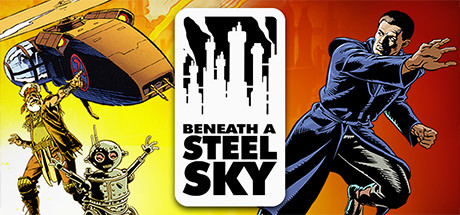
Robert Foster brought his best friend back to life to survive Union City
No deadline: it stays in the catalogue until the store pulls it.
Claim it on Steam ↗You claim it in your own store account; Clairo doesn’t claim it for you.
Availability can vary by region.
The creator of Watchmen handles the art direction, and the one obstacle that feels like nostalgia to some players is exactly what makes others walk away.
A circuit board is all the family he has left
Robert Foster walks away alive from a helicopter crash over Union City with a single companion: the circuit board holding the best friend he has left. He built that artificial intelligence himself as a boy, in the village the soldiers destroyed when they took him, and the first thing he does in the unfamiliar city is switch Joey back on. You understand Joey before you understand Union City: he is the one friendly voice that outlived the village. Everything else in the story grows out of that pair — a man with no family and the robot he invented.
Union City is a stack of towers where an oppressed population lives under the control of an artificial intelligence dictatorship, while the rich occupy the lower floors, shielded from the pollution that chokes everyone above them. Man against man, man against machine, man against time: that is how the store's own material sums up the clashes Foster and Joey face while they work out why, out of an entire village, he was the one the soldiers came for.
The art direction is credited to Dave Gibbons, the comics artist behind Watchmen — a detail the store listing makes a point of recording. And it drops one oddity without a word of explanation: the title carries 1994 in parentheses. The release date the page gives for this version, however, is July 27, 2020. A game about bringing a friend back to life reached the store decades after it was made — another resurrection, this time of the game itself.
Beyond a Steel Sky: the sequel Revolution never let go of
Plenty of studios ship a game and move on without a backward glance. Revolution Software did not follow that script: as late as 2020, the team was still speaking publicly about the direct sequel, Beyond a Steel Sky, treating it as work in progress. You feel that care without reading a single post: the studio that wrote Foster went on treating its own story as something unfinished. Its September 30 post from that year lists new achievements — rewarding behaviour the player might never have considered — and full voice acting in French and German. The studio's own records show that the story of Foster and Joey did not stop with the first adventure.
A comics artist's line and the humour that outlives the end of the world
A Brazilian player with 4 hours on the clock sums up what comes back most often: amid the story's heavier themes, what stands out, as they tell it, is Dave Gibbons' artwork — the same name behind Watchmen — fitted into a plot that mixes tragedy and comedy without sounding improvised.
Two German reviews, each logging 11 hours, reach a similar conclusion by another road: they call the game a hidden classic and recommend it above all to anyone with a taste for retro material, singling out the plot and the puzzles as its strengths — while admitting that in places they had to stop and look up help to keep going.
A player at 7 hours credits part of the result to the partner Foster carries from the start: for that review, the robot Joey's humour is what holds up a plot it describes as funny and unpredictable from beginning to end. It is a kind of humour you spot immediately: the wisecracking sidekick who lands the right joke exactly as the scene turns too heavy. Another account, at 19 hours played, praises the city's bleak atmosphere and vouches that the game runs smoothly on current machines — bringing back, in a very practical way, the same idea of rescue that opens the story.
When the old cursor collects its due
One player likes the genre and still ends the review advising against it: 8 hours in, they watched a good share of the clickable spots vanish on a large screen, and spent half the adventure with a guide open beside them. You squint to find the single spot that opens the next scene, and you cannot find it — that is the complaint. The soundtrack, by that same account, starts repeating far too early and wears thin well ahead of the ending.
The review that logs 0 hours played on Steam — perhaps because the counter never started running — goes further: it says the graphics were born dated even for releases of the early nineties, that the script reaches for adult and fumbles the joke, and that the interface pushes the player into backtracking and into dialogue that shifts with no warning.
The harshest criticism, then, is not about something the fans keep hidden: it is about the very obstacle that even players recommending the game have admitted running into. The difference is that for someone who arrived determined not to like it, that obstacle never turns into nostalgia — it turns into a reason to close the game.
It suits players willing to ask for help, not players who want answers on screen
The same sticking point shows up on both sides: at some stage the game stops handing out clues and expects the player to go looking for the solution somewhere else. That, not the genre and not the era, is what separates the players who stay from the ones who give up.
For anyone who grew up with this kind of adventure, or who is willing to accept that bargain without resentment, the very same sticking point is what keeps people rediscovering Foster and Joey decades after the original release. If you enjoy hitting a dead end and going after the answer on your own, that block is part of what works. For anyone expecting the game to point the way, it becomes a reason to walk away long ahead of the ending.
Take the deal and you get a city under the control of an artificial intelligence, a robot with a sense of humour of its own, and a plot that holds the player's hand all the way to the end. Turn it down and all you will remember is the screen where you got stuck — and the pixel the game never wanted to highlight.